


Out in the Outback

After 11 days and 1,250 nautical miles, we finally dropped the anchor in Fannie Bay, just outside Darwin.
We had officially covered a lot of Australia and somehow managed to see almost none of it.
That’s the funny thing about sailing Australia. You can travel hundreds of miles and your sightseeing consists primarily of watching the same piece of ocean move past the bow.
We made only a couple of stops along the way, and one of those was for a luxurious eight hours. Plenty of time to catch up on some sleep, make a good meal, watch a movie, and prepare to lift the anchor again.
Basically, an eight-hour vacation.

Waiting Our Turn
Once we arrived in Fannie Bay, we knew that getting into the marina was going to require something sailors are not particularly good at:
Waiting on other people.
Before entering Cullen Bay Marina, we had to have the boat inspected and treated for invasive species by Australian Biosecurity. The entire process takes about 10 hours.
There were roughly ten boats arriving around the same time, but Biosecurity was only processing two boats a day. A few boats with major repairs needed priority, so when everything was sorted out, our turn was three days away.
Fortunately, being stuck at anchor wasn’t entirely bad. It gave us the perfect opportunity to tackle the long list of things that had broken, loosened, frayed, or disappeared along the way.
There is nothing quite like several days at sea to turn a perfectly good sailboat into a floating list of maintenance projects.
Into the Marina
Finally, it was our turn.
Fannie Bay has some serious tidal changes and is extremely shallow, so Cullen Bay Marina is protected by a lock system with the marina being 10 feet higher than the bay we enter from.
We pulled up to the fuel dock, where Biosecurity began the treatment process.
The good news was that we could finally get off the boat and explore the marina and surrounding area while we waited. The marina received a major facelift about four years ago and now has plenty of shops and fun restaurants.


Having a choice of restaurants felt surprisingly luxurious. Ten hours later, we finally got the green light to enter the locks and make our way to our assigned slip.
We had made it.
Time for the Outback
We had five days in the marina, so we decided to spend part of that time doing something completely different by getting off the boat and heading into the Australian Outback.
We rented a car and drove about 200 miles toward Cooinda Lodge in Kakadu National Park.
Kakadu was absolutely worth the drive.

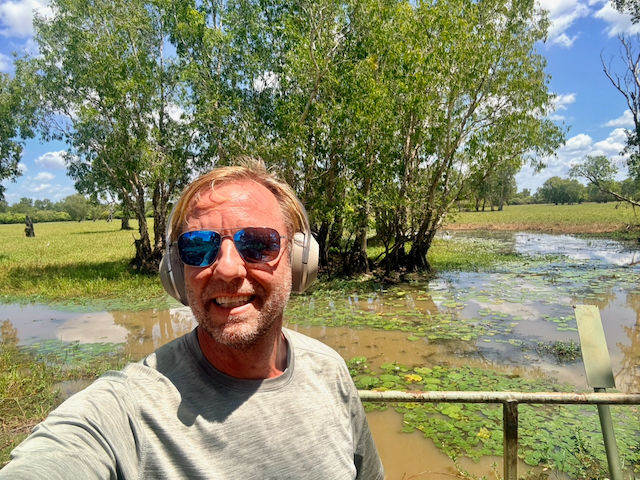
The park is packed with wildlife. We took an early-morning river cruise and saw water buffalo, crocodiles, wallabies, and at least 15 species of birds. The crocodiles were particularly impressive. They have a very relaxed attitude toward tourism. They don’t come over to say hello. They don’t pose for pictures. They simply float there looking like they’ve been waiting 65 million years for someone to make a poor decision.

This thought did cross my mind the next morning when I went out for an early run. Suddenly, every rustle in the bushes seemed a little more interesting.

The next day, we drove deeper into the Outback for a hike to see Aboriginal rock paintings and cave dwellings. After so much time surrounded by salt water, it was fantastic to see red earth, rocky cliffs, wildlife, and thousands of years of history.


Back to the Boat
After a couple of days exploring, we were back at the marina preparing for the next adventure.
The final two days were spent getting everything ready for the 950-nautical-mile sail from Darwin to Lombok, Indonesia. The weather had suddenly become increasingly hot and humid day by day getting worse (90+ degrees F, 70% + humidity). The locals were saying it was time to move south.

This leg will be extra special because our friend Josh and his mom, Jonell, will be joining us.
It’s funny how quickly my perspective changes.
You might think that after all that time at sea, I would be desperate to stay on land for a while. Instead, after five whole days tied to a dock, I’m ready to go sailing again.
And this departure feels different. We’re leaving the Pacific behind and entering the Indian Ocean. After thousands of miles crossing the Pacific, moving into another ocean feels like turning the page to a completely new chapter.
New ocean.
New country.
New crew.
New adventure.
I have no idea exactly what awaits us—and that’s probably the part I enjoy most.
Onward


Am reading The Wager by Davin Grann, setting in the 1700’s. I am getting g a better feel on just what is required of you to sail the seas. Onward. Stay safe.
It is, be carefull!
Uncle Ick